 UKEC
UKECCEKU
Wake Up Babe! It's Been Another Hot Fascist Summer
AdvocateRenee Leyyi
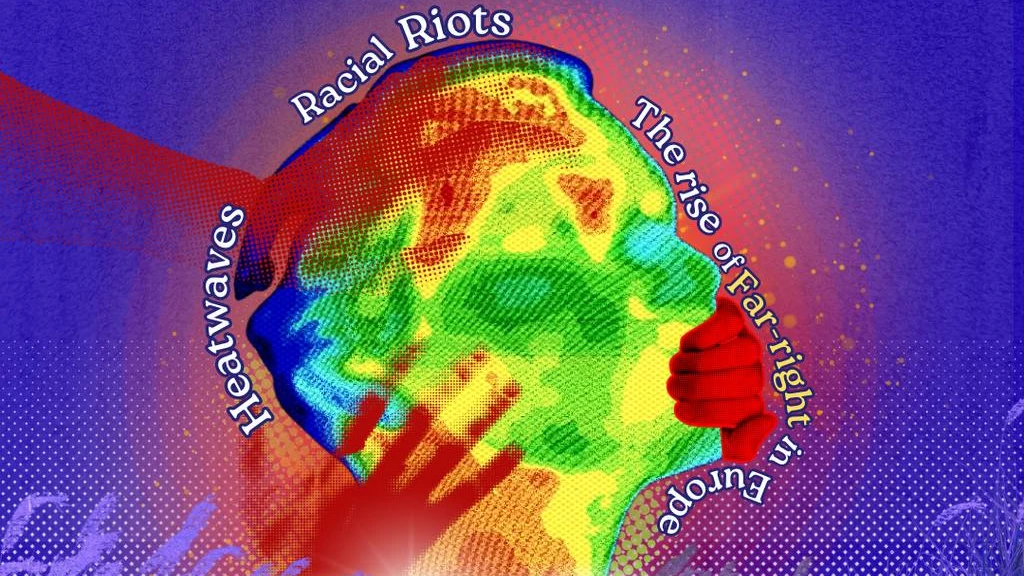
Hot girl summer, brat summer, cool girl summer, euro-summer — we've heard it all, but what has happened without fail during these past few summers is the rise of fascism as temperatures rise to impossible degrees.
In August 2024, a month before I was to return to London for my second year of university, my uncle — who rarely texts me — sent me a link to a TikTok video. The video has been taken down, along with all the videos that were recorded in first person by participating right-wing supporters. In the video, people were holding up flags of St. George's Cross and 'MEGA' signs. It was obviously somewhere in the UK.
They were cheering, hollering, chanting, shouting something I don't remember because all I could focus on was the tree in the background. I recognised that tree, that street, those stores—
—It was in London. Central. Horrifically close to Chinatown where my friends and I hang out all the time.
But... they wouldn't do anything to Chinatown, I thought to myself. They like the food there. They like the culture it brings to the city, the culture that has become easily palatable to them, the tastes they no longer wish to be assimilated or erased. "One of the locals' favourite areas in London", they say. They like us there, just right there.
Soon after, another relative texted me about it, along with supposedly reassuring messages: "Just stay in the right areas. They're targeting Muslims for now, but be careful." All I could think about was my Muslim friends whom I've met there, and how they'd feel about going back for the semester. I stared at the "for now" in their message, because I knew it was true.
That night, in ever-hot and humid Malaysia, I felt my fingers run cold. As I scrolled past video after video reporting these incidents, every part of me turned numb but the horrified beating in my chest.
They were not only happening across the UK. They were also happening all over Europe and America. These far-right racist protests have been happening every single summer since then. Anti-Asian sentiments from COVID-19 grew into anti-immigration and anti-refugee movements as people looked towards a possible solution to their struggle with inflation, the rising cost of living, and unemployment. With right-wing politics falsely claiming immigrant deportation as the one-for-all solution to the aforementioned issues, migrants became easy targets — an outlet for hatred and violence out of "white victimhood".
Back in August 2020, when temperatures reached 32.5°C in Sweden, there was a Qur'an-burning rally by supporters of a right-wing politician in Rosengård, a predominantly immigrant neighbourhood, which induced counter-riots.
In the summer of 2024, organised far-right riots broke out all over the UK, while the far-right German political party, Alternative for Germany (AfD), "despite — or because — of its anti-immigrant rhetoric, plans and actions, [...] achieved electoral successes in EU, local and state elections in the past few months." Then in 2025, more anti-migrant protests burned the UK with racial and female violence alongside deadly heatwaves.
Heatwaves in Europe have killed an excess of 10,000 people during this summer alone.
Recently in June 2026, riots broke out in Belfast once again. They deliberately burned the cars, stores, and homes of people they deem "satanic" while they put up AI-generated anti-Islam posters. According to The Guardian, "this was to be the third consecutive summer of racial disturbances in Northern Ireland", where a heatwave is heading towards the region for the fourth time this year. A few months back in May 2026, thousands of far-right supporters took to the streets of London to oppose a pro-Palestinian protest and declared their white supremacist need to "put Britain and the English people first".
It is as if these folks are trying to fight fire with fire as these men swing torches of their rage around their own neighbourhoods. Every summer, a wave of primal irrationality takes over this specific population and arouses them to set their country ablaze like a dried-up field.
The question is, why? Is it really a coincidence? Is it just that a warmer climate causes erratic behaviour and makes for a more conducive environment for violent gatherings?
Yes and no. A 2025 study suggests a direct correlation between increased temperatures and riots. Rising ambient temperatures increase irritability and aggression, reduce inhibition, and heighten arousal — all of which align with the temperature-aggression hypothesis, which proposes that high temperatures lead to discomfort and therefore aggression. Furthermore, the hypothesis aligns with the General Aggression Model, a framework which suggests that a person's reactions are usually influenced across the domains of ‘affect’ (discomfort or pain that increases anger and hostility), ‘cognition’ (media or social priming that allows conditions for increased violence), and ‘arousal’ (situational arousal that amplifies aggression in response to provocation); thus, it verifies the increased likelihood of impulsive violent behaviours even with minimal provocation. Additionally, it has been proven that increased temperatures induce states of psychosis, neurosis, self-injury, and inflicted injury.
Meanwhile, the Science and Environmental Health Network reports that it is easier to abuse real immigration from droughts and crop scarcity through imagined in-migration and stereotypical xenophobic conspiracies. As climate change disrupts the once reliable patterns of water sourcing, residents of global water-stress hotspots, especially farmers, face crop scarcity, leading to migration within and beyond national borders. The water bankruptcy crisis is also affected by groundwater extraction by capitalists in agricultural regions. Human migration, directly or indirectly forced by capitalist schemes, has always been framed by xenophobic nationalists as the main factor for “local culture” erosion and decreased quality of life. To stoke fear and aggression, these public figures would even overstate the occurrence of real migration into an exaggeration of imagined threats. These narratives that provoke defensive violence against “outsiders” are easily popularised when a people feel insecure about their future due to economic instability. They build up to the rise of right-wing neofascism when citizens are deflected from internal reflection of those in power and made to believe that immigrants are the explicit threat to their nation; such is how climate change, water scarcity, increased migration, and the rise of fascism interconnect. And of course, it is during summer that the consequences proving the connection between these factors become more apparent.
However, as Weymouth puts it, "There has long been a vein of far-right ideology running through the politics of nature. It is found in Thomas Malthus’s early-19th-century racist warnings of an overpopulated future; in the colonial mindset of the degeneracy of the tropics and its people; in the dispossession of Indigenous lands to clear the way for the first national parks in the US."
Fascism is something that feeds off instability, fear, and crisis. When immigration is made to be the sole enemy of a state, we cease to view people as rightful humans. We rigorously comment on these phenomena across seas, but truthfully, fascism is on the rise worldwide, and it is among us. We are not spectators, but participants in this blight. This is apparent when we look at the neo-Nazi declarations by fellow Malaysians on public internet spaces regarding Rohingya refugees.
We are, and we have been, living in hot fascist summers these past few years. What we can do is hold on to hope that systemic authorities do not have absolute power over our society — for there is power in the actions of the common people. Among ourselves, it is important to practice our tolerance for ambiguity and differences between us. Another crucial thing is to question what we consume. With proper media analysis and literacy skills, we can avoid being susceptible to extremist ideologies, which are consistently fueled by biased headlines, right-wing conspiracy theories, and unregulated social media content.
As our climate remains the punching bag absorbing every single environmental impact of our actions, we should remember that our habits do matter — no matter how inconsequential they may seem against others’ inaction. This applies to caring for both our fellow human beings, and the environment we share. As a wise person once said, to be part of a village, we first need to be a villager ourselves.